
From Editaton to Wikipedia: 10 Chilean scientific institutions now have published articles
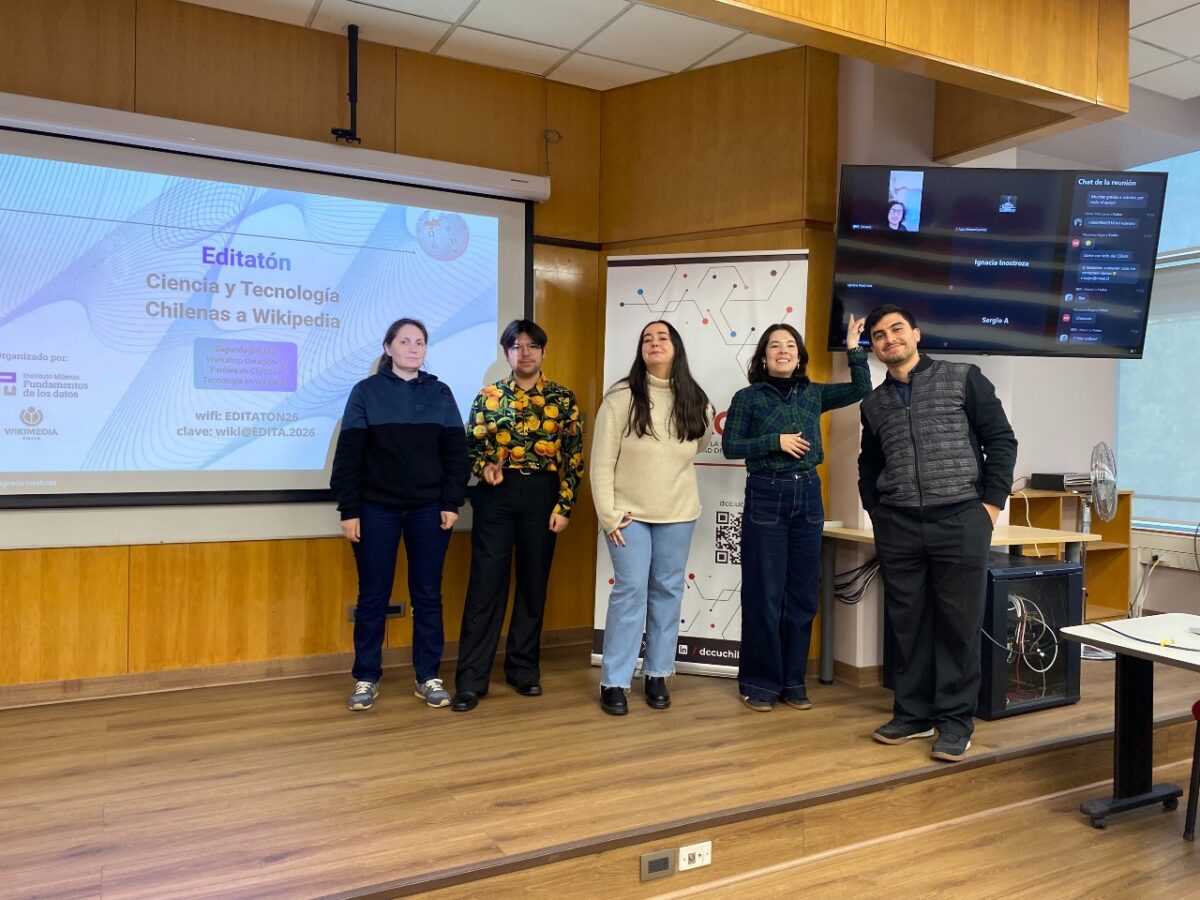
The Science and Technology Editaton 2026, organized by The Millennium Institute for Foundational Research on Data (IMFD) together with Wikimedia Chile and with collaboration of the Department of Computer Science of Universidad de Chile, brought together 14 institutions. Ten of them completed all stages of the process and now have published articles on the free encyclopedia.
In June of this year, 14 scientific and technological research institutions in Chile took part in the Science and Technology Editaton 2026, organized by The Millennium Institute for Foundational Research on Data (IMFD) together with Wikimedia Chile and with collaboration of the Department of Computer Science of Universidad de Chile. After the editing, review, and publication process, ten of them now have a new article on Wikipedia.
The initiative sought to bring scientific and technological research institutions and centers closer to the tools and editorial criteria of this digital platform, promoting a greater presence of Chilean science on one of the most widely consulted open knowledge platforms in the world.
The criteria behind a Wikipedia article
One of the main lessons learned from the editaton was that Wikipedia operates under specific editorial principles. These include encyclopedic relevance, verifiability, the use of reliable and independent sources, a neutral point of view, and the absence of original research.
Encyclopedic relevance, for example, means that an institution must have significant coverage in external sources to justify the existence of its own article. It is not enough to have a track record, a website, or institutional publications: there must be information about it in independent sources, such as media outlets, books, academic publications, or public institution documents.
On the other hand, verifiability requires that relevant data can be confirmed through published references. Thus, information about the founding of an institution, its research lines, awards, or projects must be backed by sources that allow readers to verify and delve deeper.
Another fundamental aspect is neutrality. Wikipedia articles do not seek to promote or defend an institution, so they must avoid qualifiers and prioritize the description of concrete, verifiable facts.
Finally, the principle of no original research establishes that Wikipedia is not a space for presenting new interpretations or conclusions. Its function is to compile and synthesize knowledge that has already been previously published in reliable sources.
10 institutions are already on Wikipedia
As a result of the process, ten institutions have completed the stages of the editaton and their articles are now published on Wikipedia:
- Millennium Institute Foundational Research on Data (IMFD)
- Regional Center for Studies on Healthy Foods (CREAS)
- Center for Advanced Research in Education (CIAE)
- Millennium Institute for Research in Optics (MIRO)
- Valparaíso Scientific and Technological Center (CCTVal)
- Advanced Center for Transportation, Logistics and Economic Competitiveness (CATLEC)
- Millennium Nucleus of Advanced MXenes for Sustainable Applications AMXSA
- Institute of Indigenous and Intercultural Studies (IEII)
- Science & Life Foundation (FCV)
- Millennium Institute in Immunology and Immunotherapy (IMII)
The publication of these articles helps expand the information available about institutions that carry out scientific and technological research in Chile and facilitate access to their trajectories, areas of work, and contributions through an open platform with global reach.
Want to learn the basic principles of editing on Wikipedia?
Read here the “Brief manual for editing articles about scientific and educational institutions on Wikipedia in Spanish”, prepared by Wikimedia Chile and used in this editaton.